We are the Last Bottleneck
What AI can do is expanding faster than we can absorb it, changing how we solve problems, relate to technology, and involve other people.
A few weeks ago, my grandpa made a small leap in how he uses ChatGPT.
He was travelling in a foreign country (Poland) and needed to figure out which platform to use to catch a train. Normally he would have asked someone for help nearby or tried to work it out himself. This time he opened ChatGPT and asked
It was not the first time he had used ChatGPT. He made a leap and was bringing it into an ordinary problem that he would previously have solved another way. He could not give a shit about AGI, benchmarks, or which AI system is winning this week. He was stressed out and only wanted to find the right platform in a country where every sign was in a different language than he understood.
There is a wide gradient between using AI like search, involving it in how you solve everyday problems, and working at the frontier. My grandpa took a step and moved slightly along that gradient during that moment.

I am 5 weeks into a new role at OpenAI which puts me unusually close to the frontier of that gradient. I consistently fail to keep up with the pace of our industry, despite being an early adopter for years by this point.
Living that close to the frontier skews your sense of what AI usage looks like. What feels revolutionary there has barely started becoming normal elsewhere.
What AI can do changes faster than we do
Most of our relationship with technology is built through repetition and problem recognition. We learn what a tool can do, where it fails, and when it is worth reaching for.
You search for an answer. You ask a friend for advice. You hire someone with a skill you do not have. You avoid a project because it would take too long. You do a task manually because explaining it would be more work than doing it yourself.
None of these are decisions you carefully revisit every morning. They are assumptions formed across thousands of moments. They make the world manageable because you do not have to rediscover its boundaries every day.
AI has made technology advance at a much higher pace, while also making non-linear improvements. Those non-linear improvements break our core assumptions and problem recognition built up over years.

A task that was not worth attempting can suddenly take an afternoon. A workflow you dismissed after trying it once may now work. A skill that took years to build can become cheap, while judgment you barely thought about becomes the valuable part.
I have written before about what it feels like to build on a moving train. That piece was about infrastructure: an abstraction that made sense 3 months ago becomes wrong when the entire landscape underneath it changes. Our assumptions break the same way. One that was sensible last month can be wrong today.
People burn out trying to keep up with these changes. During 2025 I spent a huge chunk of my mental energy to do so, and I got paid doing so when I was running my own company. To keep up you have to absorb every new capability, you have to tear apart your view of the world, test whether an old limitation or core assumption still exists, change your behaviour, and sometimes reconsider where your own value comes from.
I constantly fail at this, and I’m definitely not alone. I increasingly run out of ideas. I disregard improvements or new patterns without trying them because I am tired. I know I should revisit more of my assumptions and repeatedly test what is possible now, but continuously shedding your own beliefs is exhausting. Every meaningful update carries a small identity question with it: what am I still good at, and what is my place in a world where the division between human and machine work keeps moving?
It is a quieter and more frequent process than the existential crisis about AI taking every job. You rebuild a small part of your identity around a new reality, then the reality changes again before that identity has settled.
A tool that asks something from you
There is another strange property of AI: to get something out of it, you have to put something in. Every tool needs input, but most have a bounded role. You know what a search engine or calculator is for, and it asks little beyond operating it correctly. A general-purpose AI tool is different. Its possible uses grow as its capabilities improve. It can help you write, investigate, plan, decide, or create. That sounds like pure abundance, but it hands a difficult question back to the user: what do you actually want?
What AI can do is expanding faster than we are finding new uses for it. Our intentions, imagination, and behaviour do not double because a benchmark did. When a tool can help you do almost anything not knowing what to do with it feels uncomfortable. The hardest part about doing new things have shifted from knowing how to make something to knowing what is worth spending time & energy on.
Taste is too small a word
In February Paul Graham predicted that “in the AI age, taste will become even more important. When anyone can make anything, the big differentiator is what you choose to make”. Greg Brockman followed with “taste is a new core skill”, and Twitter spent weeks debating and memeing taste (still is, to some extent).
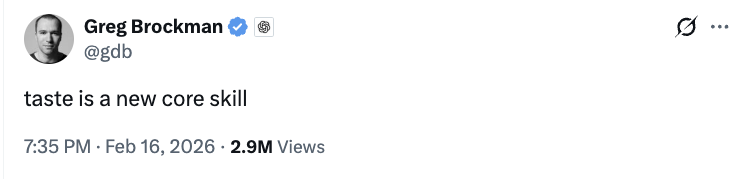
The argument made is that AI makes execution cheap so taste becomes the moat. Anyone can now execute on almost every idea, and the valuable person is the one who can tell which is good.
That argument assumes someone has already noticed the possibility, understood the problem, decided to involve AI, provided enough context, and produced something worth judging. Taste describes how we judge what comes out. It says much less about what we have to put in.
My grandpa did not have a taste problem. He had a train to catch and had not previously thought to bring ChatGPT into that kind of moment. His behaviour changed through an ordinary problem, not through an abstract understanding of what AI could do.
Who do we bring into the problem?
I keep returning to an uncomfortable question: if AI becomes better than a friend at giving me advice, do I still ask my friend?
Getting actual advice is only part of what reaching out to someone achieves. Asking a friend expresses trust, and it creates a larger exchange that tells them what is happening in my life. It keeps the relationship alive.
AI can satisfy the practical need, but it does not replace humans in those moments. I wonder if we all will stop bringing friends into moments that once sustained the relationship, and be more socially isolated as a result.
Work has the same shape. It produces output, but it also lets people contribute, build relationships, earn recognition, and locate themselves within society. When AI participates in the output, it can change all of those things around it.
None of this argues for preserving pointless work or choosing worse answers to keep ourselves useful. But when AI becomes the most capable and convenient participant in more of our lives, we should notice what we stop asking of each other.
Can interfaces keep up for us?
Asking people to keep up is not going to work. Traditional software exposes its capabilities through buttons and menus. General-purpose AI cannot.
I saw this while rolling AI out to more than 900 engineers. Behaviour changed when people saw AI applied to a real problem and had space to try it themselves, not when they were told how powerful it was.
Natural language may already be part of the answer. Karpathy called English the hottest new programming language back in 2023. My grandpa proved the point without knowing it: he did not need to know which capability could help, he just described what was happening in the same language he would have used with another person.
That may become ingrained the way search did originally with Google. People stop thinking about whether they are using AI and start including it into planning a trip, learning something, or making a decision. The technology disappears from the description of the activity.
Opening a chat and asking may only be the current version. An interface that keeps up with expanding capabilities on our behalf would also make AI the easiest participant to involve: it could change who we ask, what we do ourselves, and the roles we leave for other people.
We are the last bottleneck
Calling humans the last bottleneck can sound insulting, as if people are the slow component standing in the way of progress. We are slow because our behaviour is attached to who we are and to the people around us. We cannot update those things like software dependencies, and not every part of them should be rewritten because AI gets better.
Maybe this bottleneck shrinks as interfaces to AI learns to keep up for us and involving AI becomes more natural. The easier AI becomes to involve in ordinary life, the more it changes who and what we involve instead.
What AI can do will keep expanding. 5 weeks close to the frontier has not made me think the world is short of intelligence. It has made me realise how much progress asks from the people expected to absorb it.